Pages

Saturday, October 7, 2017

Phantom Lake Railroad

I had meant to post a few pictures back in late July after a visit to the Norm Baullinger's Phantom Lake Railroad. The purpose of the visit was a Puget Sound Garden Railway Society new member meet, greet and learn. It was an opportunity to meet some other garden railroaders and questions of people who might have some answers. So in the spirit of better late than never, here is a belated post with some of my photos from my visit in July.

A beautiful high trestle with a lake in the background.

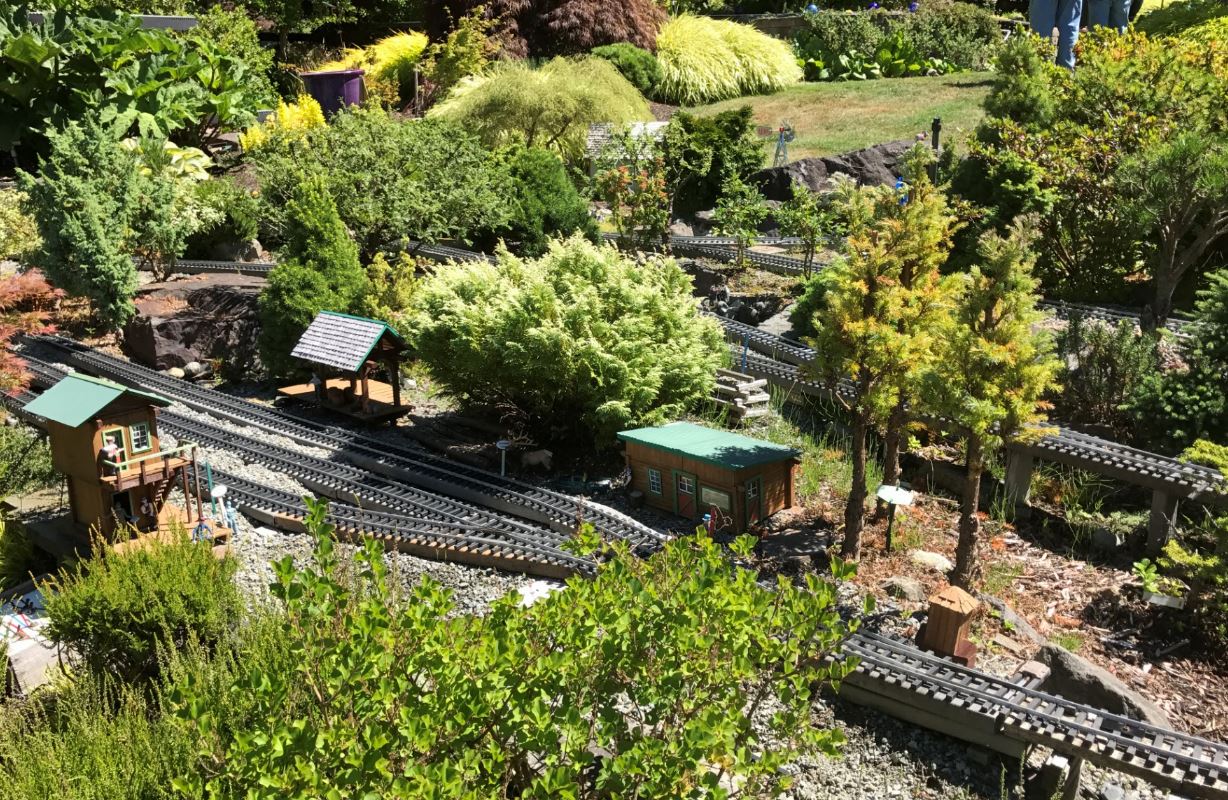
Hundreds of dwarf trees and other plants decorate the railroad. Here the line passes by a small station and a few other buildings with a couple of siding tracks.

It ended up being very informative afternoon and I asked lots and lots of questions which helped me get through some indecision I was having about next steps. Decisions that I came to:

  • I'm not going to waste any more time trying to keep my current layout electrified. My focus instead will be on converting all my locomotives to radio controlled battery power. All the work I am doing to keep the current track powered just isn't worth the effort.
  • At some point I will likely add a small powered loop (maybe 40-50 feet) that is separate from (or maybe just insulated from) the main layout so I can still run locomotives I am unlikely to convert, like my PCC streetcar.
  • I will be going with AirWire for my RC provider, which is the direction I had been leaning.
  • I will be using 18V rather than 14.8V batteries. And to start with I'm going with Makita.

I haven't completed my first locomotive conversion yet but I now have most (not all) of the parts on hand so that will be happening in the next few weeks. Look for a post on that soon!

Norm has been working on the Phantom Lake Railroad for many years and it has been growing in phases over time. There are now several hundred feet of track and also hundreds of beautiful plants and miniature trees. In the older sections of the railroad the flora has matured and it's amazing how well the railroad blends into the environment. In some sections the track is primarily at ground level on a floating roadbed, and in other sections it is elevated a few feet above the ground on posts. There are also multiple bridges, trestles and tunnels.

Thank you to Norm, Brent, Mark and everyone else I met while I was there.


Lots of beautiful trestle work, often curving with elevated switches like you see here. Note the large building in the background and the railroad boxcar converted to a bunk cabin.

Nice cribbing! Another thing on my to-do list.


One of my favorite spots was this rock-lined ravine.

Close-up detail showing a family of bears looking over the ledge. Don't get too close!

A couple of trains in the yard waiting to go out on a run.

This photo shows the use of the floating roadbed and provides a good example of how well integrated the dwarf conifers and other trees are within the railroad.

Here's a view of the railroad looking east, and you can hardly see it! My favorite thing about this railroad is how well integrated it is with the vegetation. You cannot tell which came first—the garden or the railroad.

A view looking down toward the railroad's namesake, Phantom Lake. Today's lake is a remnant of what was once a much larger but relatively shallow lake which was partially drained in the late 19th century to create more farmland. Occasionally in very wet winters the lake level will rise and Phantom Lake will try once again to take on the appearance of what it looked like 125 years ago. Today the farms are gone and the lake is mostly surrounded by houses built in the 1950s and later.

Just for fun, a detail of a map from c. 1897 showing the modern Phantom Lake in the middle. The current name of the lake dates to 1894, when the drainage of the lake was rerouted toward Lake Samammish as seen on this map. Previously, Peanut Lake drained to the north toward Kelsey Creek. The archive I pulled this map from has it dated 1895 but I think 1897 is more accurate. Note the railroad running along the east side of Lake Sammamish—this is the line out to Snoqualmie that was built by the Seattle, Lake Shore & Eastern. On this map it is labeled as Seattle and International Railroad, reflecting its name change that occurred in July, 1896.

Sunday, October 1, 2017

An old train shed finds a new home

Last weekend I acquired a train shed from fellow PSGRS member Ralph Olsen who was giving it away to a good home. When I found out he only lived a half-mile away I was there in no time to pick it up. It wasn't until today that I had the time get outside and clean it up.

The shed is approximately 24 x 60 inches with doors on each end. It's wide enough for three tracks inside (or possibly four?) so it will provide storage space for several cars.

The shed upon its arrival, in need of a little TLC.

The structure is in very good shape except for the roof, where a few panels have cracks and some of the battens have broken off. This will be very easy to fix—I just need to find some similar cedar panels and I can cut them to size and swap them out. The sides are painted and the color happens to match my garage, so when I repaint the garage next year I'll repaint the train shed too.

Detail showing the roof. A few cracks here and there and some missing battens, but still structurally sound.

Once I had the roof off I cleaned out the shed and scrubbed down the floor. So many spiders!

Drying in the sun after a good scrub down.

My goal for today was to clean it up and put it up on a foundation so that the wood isn't resting on the ground. I'll wait until spring to make a decision on a permanent spot and then run track into it. For now I selected a spot on the east side of the garage where I could easily run a spur off the mainline. And the garage overhang will help protect the train shed from the weather over the winter.

Site preparation included clearing the area, spreading out some gravel and sand to help level out the terrain, then spacing bricks to provide a temporary foundation and elevate the structure above the ground.

Here is the shed in its location for now. If I decide to keep it in this area permanently, I'll probably move it back a few feet and also a bit further away from the garage so that there is a larger air gap between them.

So thank you Ralph and Lynda for the new (old) train shed for the PE&A!

After the shed was in place it was time for a cup of coffee and a stroll around the yard to enjoy the dahlias.

It may be October but most of the dahlias are still doing pretty well. Some in particular are still producing incredibly large and brilliant blooms, unusual this late in the season, such as this one called Bell of Barmera.

I don't know what this one is called but it has become one of my favorites. I got this along with a few others at a fundraiser auction at the West Seattle Senior Center several years ago.

And this one, called Firebird, was a new addition last year.

Wednesday, August 30, 2017

Northwest Railway Museum

A few weeks ago we visited the Northwest Railway Museum in Snoqualmie. It happened to be the one day this summer that the Seattle area received any measurable precipitation, but the rain was so light and refreshing we hardly noticed it.

The museum operates trains on the weekends that originate at the historic Snoqualmie Depot, originally built in 1890 by the Seattle, Lake Shore and Eastern Railway. The building had been heavily modified since then and used by the railroad up until the line was abandoned in 1975. At that time the depot and several miles of track were donated to the Northwest Railway Museum, which restored the depot in 1981 to better reflect its original appearance in 1890.

Snoqualmie Valley Railroad #4024, idling in front of the historic Snoqualmie Depot, is warmed up and ready for another day of passenger service.
On the back side of the depot you'll find a Baldwin 2-6-6-2 Compound Mallet built in 1926. After retirement from active service it was placed on display on the University of Washington campus from 1961–1972. After some work by museum volunteers, it steamed under its own power from UW to Kenmore before the old SLS&E tracks were removed to make way for the new Burke-Gilman trail.

The SLS&E was chartered in 1885 with the ambitious plan of crossing the Cascades to connect Seattle with Spokane. A line was constructed east from Seattle in 1887-88 as far as Sallal Prairie, about seven miles further east from Snoqualmie. And in 1888-89 a line was constructed west from Spokane which made it as far as Davenport. Those two lines never went any further.

A third line was constructed in 1889-91 from a junction in Woodinville north to Sumas on the Canada border where it met the Canadian Pacific. It was clear this was the most important line and the Northern Pacific took a strong interest in the railroad, viewing the Sumas branch as a route into the Vancouver area. After falling into receivership during the recession of 1893, the railroad was reorganized as the Seattle & International Railway Company in 1896, and was fully merged into Northern Pacific in 1901.

The day we visited the museum was operating a diesel switcher pulling three passenger cars. We rode in the back car, ex-Spokane, Portland & Seattle car 272, a combination baggage/coach car built in 1915 by the Barney & Smith Car Company of Dayton, Ohio. We sat in the baggage area as the baggage doors were open so we had an unobstructed view.

Locomotive 4024 is a Baldwin RS-4-TC built in 1954 for the U.S. Army.
SP&S 272 is the car we rode in next to the open baggage door.

SP&S 218 was originally built in 1912 by Barney & Smith Car Company. It was in use throughout much of the 20th century and was purchased from Burlington Northern in 1983. It has been substantially and lovingly restored to its 1912 appearance.

Another view of SP&S 218 from the interior. Look at the beautiful green stained glass along the clerestory windows. By chance, later in the day we ran into the volunteer who did the glass restoration work on those windows.

The third passenger car on the train was completely empty as the crowd wasn't very big for this run, and everyone apparently preferred the other cars. 

The train travels along a section of the preserved SLS&E track between Snoqualmie Falls and North Bend. This is an orphan stretch of track -- it no longer is connected to the outside world. Much of the former line out to Snoqualmie has been converted to the Burke-Gilman multi-use trail.

The train excursion includes a stop at the museum’s Railway History Center, which includes a the Conservation and Restoration Center, a Railway Education Center, and the Train Shed Exhibit Building which houses several locomotives and pieces of rolling stock in various states of restoration. Some of the pieces have been meticulously restored to like-new condition, while other pieces are waiting for their turn. Unfortunately the train was behind schedule that day so we didn’t have as long at the exhibit building as we would have liked. We’ll just have to go back again sometime soon!

For additional information:

One of the preserved but not restored Northern Pacific cabooses in the train barn.

A restored 40-foot Northern Pacific wooden boxcar. It looks like it just rolled out of the factory.

After lunch, we went to the Puget Sound Energy Hydroelectric Museum, which includes two beautifully restored and preserved structures. One is the Snoqualmie Falls depot, and the second is a former machine shop which is the structure on the right. Both buildings now house museum exhibits about the Snoqualmie Falls hydroelectric project.

It was the middle of summer so the river was running quite low, but the falls were still beautiful.

The train passes right next to Twede's Cafe in North Bend, which I still refer to as the Mar-T Cafe, and is known by the residents of Twin Peaks as the Double-R Diner.


Sunday, August 27, 2017

BJ&J of Maltby

More than one person has pointed out that I have been quite remiss in new posts recently, as it's been at least six weeks since the last one. Part of the reason is that there hasn't been much to report on the PE&A. There's been very little activity this summer and no track expansion, first due to over protective robins, then invasive ground wasps, and recently most of my time has been diverted to more pressing yard work such as tree trimming in preparation for reroofing of the house and garage.

But there hasn't been a complete lack of train related activities in July and August, and of course I do have lots of pictures. So I think I'll put together two or three posts this week to share a few places I've visited in the past two months, starting with a visit yesterday to the BJ&J of Maltby during the Stuvland's annual open house.

Like many garden trains the BJ&J started quite small on an open space beside the house and has gradually grown over the years. A 2000 gallon koi pond appeared for the train to encircle, a small town grew up in another area of the yard, and more recently a logging camp opened up on a ridge above town. There's at least 700 feet of track connecting it all and providing access to an indoor train yard.

This is clearly Great Northern territory and probably about 90% of the rolling stock is GN.

A GN U25B hauling a short mixed train idles at the town depot before taking off for a run.

A train heads north out of town across the long trestle. I think that's a EMD GP30?

Full train of logs heading up a curved trestle. You know I like log cars!

And I really liked this water tower because of the wire rope detail.


Here the track heads over a log bridge supported by log cribs, something you might see when a temporary track was put in place to access a logging camp.

With all the logging activity going on, I wasn't surprised to see a fire lookout tower. It's been incredibly dry this summer, and the forests need to be protected!

I think my favorite part of the layout was this intersection, with a curved wooden trestle in the foreground, a drop girder bridge behind it, and up above is another drop girder bridge supported by reinforced concrete piers (actually, wood and PVC in this case.)

Alco F-units (A-B-A) head out from under the deck into the bright sun. Beautiful day for an open house.

Here are the same F-units descending the helix. It's hard to tell from this picture, but the top level of the helix is design to look like a snowshed.

A large shed includes a seven-track yard.

A visiting Canadian Pacific RDC passes by town.


Sunday, July 9, 2017

Chehalis-Centralia Railroad & Museum

This weekend we paid a visit to the Chehalis-Centralia Railroad and Museum, just south of Centralia in Lewis County. They've been operating a restored 1916 Baldwin 2-8-2 "Mikado" for almost 30 years along a section of track that was once a branch line of the Chicago, Milwaukee, St. Paul & Pacific and today owned locally by the Port of Chehalis. The route winds through a pastoral setting along the Chehalis river upstream from Centralia for about 10 miles.

Cowlitz, Chehalis & Cascade No. 15, a 2-8-2 "Mikado" built by Baldwin in 2016. It just turned 100 last year!

View of the Chehalis river, running low this time of year.

This was a former diamond crossing with a Northern Pacific branch line, which today is the Willapa Hills Trail. These two lines closely followed each other for about 20 miles from Centralia, then took separate routes to reach Willapa Bay.

A sampling of the bucolic views along the route.

When the train reaches Milburn, a siding and former junction with the Northern Pacific, the locomotive disconnects and does a run around of the train so it can lead the return trip.

Operations on the PE&A have been halted temporarily. I was out watering the train area last week and was attacked by two wasps. Apparently a nest has been established very close to the right-of-way. I haven't located its exact position but I have narrowed down its location so I hopefully will be able to eradicate the problem soon.

In the meantime, it's finally summer so enjoy some pictures of the current flora.

I have a few varieties of daylilies and this one is my favorite.

This laceleaf hydrangea is at peak bloom right now.

Another favorite blooming right now is this Lilium columbianum. 

A honeybee coming in for a landing on the hedge in front of the house which is in full bloom right now. This is a favorite of the honeybees this time of year and hundreds of them cover the hedge from sunrise to sunset.

And speaking of bees, this bee balm is more attractive to hummingbirds than it is to bees.