Pages

Wednesday, June 13, 2018

NGRC Atlanta Update 2

Here are some more pictures of the garden railroads I toured around Atlanta last week. These are from the Thursday tour, and we only made it to four railroads as a lot more driving was involved than Wednesday. But all four of these railroads were great and definitely worth the trip. Thursday also included a stop by Trainz.com for a tour of their facility which was fun.

Pick-N-Grin Railroad | Jesse and Kim Murrah | Sugar Hill, GA

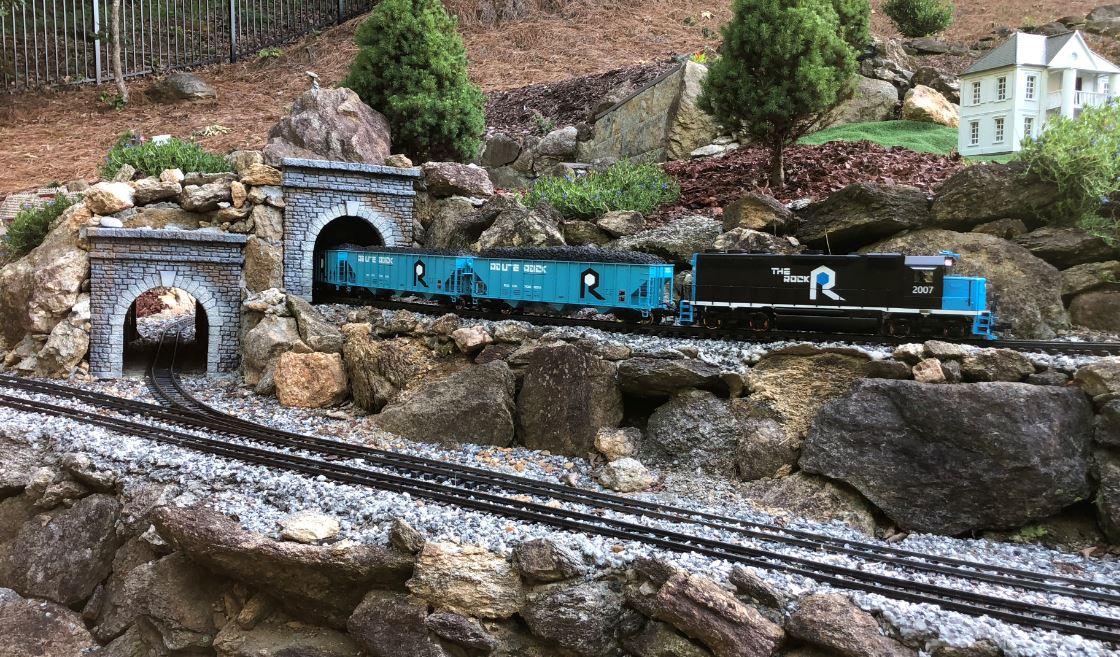
Pick-N-Grin: This amazing railroad is built on, into and next to a natural rock outcropping, which strongly influenced how the train could be laid out. And while the setting may have been rural Georgia, seeing the Rock Island (a Chicago-based line in the Midwest) still seemed totally appropriate.

Pick-N-Grin: Because of the change in elevation, multiple curved trestles and bridges are required to keep the track at a relatively modest grade.

Pick-N-Grin: At one end, tight return loops are hidden behind a hillside and tunnels.

Pick-N-Grin: Not one but two streams run through it, with a lovely waterfall on one of them. I also really like these bridge piers—I'm now thinking I may want to incorporate stone into the piers on my railroad, rather than just using plain concrete.

Pick-N-Grin: Campers on vacation enjoy some live music.

Pick-N-Grin: And I really enjoyed this scene as well. The attention to detail here is amazing.

Frog Mountain Railroad | Dennis and Ellen Bass | Snellville, GA


Frog Mountain: Freight train passes a passenger train stopped at the depot.

Frog Mountain: A beautiful canyon cuts through the middle of the layout, with a road bridge overhead.

Frog Mountain: Not the most common location for a wedding. Is this a metaphor for taking a leap of faith?

Frog Mountain: They had a second, small train loop running next to the driveway with a watermelon train! The watermelons are hand painted pecans—another idea I'm going to have to borrow.

Mount Jefferson Garden Railway | Terry and Ginny Manning | Lilburn, GA

Mount Jefferson: I think my eyes wondered over this entire layout and I'm sure I missed things. There was an amazing amount of details layered in. The main feature was this wonderful zoo.

Mount Jefferson: And there was also an outdoor animal preserve that was encircled by a safari train. 

Mount Jefferson: Holsteins are always a nice addition to a garden railroad. So much detail for such a simple scene—the multiple cows, the fence, the windmill, the signage, the feed trough and water barrel, the old tractor, and even a dog house.

Mount Jefferson: This new addition on to town doesn't even have train service yet—but it will.

Mount Jefferson: I think this was my favorite of all the structures in town.

Mount Jefferson: And this backyard scene with quilts on the clothesline was perfect.

Flat Top & Mystic Valley Railroad | Joe and Debbie Fotschky | Duluth, GA

Flap Top & Mystic Valley: The more I looked around this railroad, the more I realized just how much work had gone into it. There is a very high focus on realistic detail, and an incredible amount of effort was spent building some of the features. To the right of the double-track railroad is a highway made from poured concrete. Some side roads were also concrete and others were gravel. Note the utility poles running along the railroad.

Flap Top & Mystic Valley: Here the rail line cross the road, with another crossing next to it for a short industry spur. Note the detail of the inset road crossings.

Flap Top & Mystic Valley: The layout runs the full length of the backyard, and the the layout progresses from a small town to a more rural setting to a mountainous setting. Here the train passes a farm. The horses are safely corralled, but the cattle seem to be free range.

Flap Top & Mystic Valley: The two tracks have independent tunnels, each with a different approach. While the wood trestle is very nice, the poured concrete viaduct is amazing.

Flap Top & Mystic Valley: Train emerging from the tunnel on the outside track.

Flap Top & Mystic Valley: Another fun scene, an off-leash dog park that somehow has far more dogs than people!

Sunday, June 10, 2018

The General and the Texas

I'm going to take a brief break from garden railroads to talk about the General and the Texas. If you aren't familiar with these two locomotives, they were involved in the Great Locomotive Chase on April 12, 1862. Long story can be found on Wikipedia and many, many other sources. Short story: Small group of U.S. soldiers led my a civilian successfully infiltrate Confederate occupied territory, steal a fast locomotive (General) along with a few boxcars of explosives in Marietta, Georgia and take off for Chattanooga with the plan to blow up a few railroad bridges on the way. The conductor of the hijacked General pursues the stolen locomotive using a hand truck, then using a locomotive (Yonah), and then a another locomotive (William R. Smith), and then a third one (Texas) and finally catches up with and captures the U.S. Army soldiers, due in large part to some truly stupid moves by their civilian commander. Many of the captured U.S. soldiers are executed. The soldiers who survive are the very first recipients of the U.S. Medal of Honor and those who were executed are eventually awarded medals posthumously.


None of the four locomotives involved were that unusual, but are famous because of this one incident on one day back in 1862. After the war, all went back into service on railroads. Two of the locomotives had rather inauspicious ends -- the Yonah was likely turned into a stationary boiler in Atlanta around 1873, and the William R. Smith likely had a similar end. In time, as the story of the Great Locomotive Chase became more familiar, the value of the two surviving locomotives was recognized and both were eventually preserved. There have even been custody fights over both locomotives as their value has increased over time. Both have gone through multiple changes and restoration processes.

I'm familiar with the story and I've seen both locomotives before, but this week was a special treat as I had the chance to visit the General on Wednesday at the Southern Museum of Civil War and Locomotive History in Kennesaw. And then on Thursday I attended a wonderful presentation at the NGRC about the details of the chase, presented as first-person accounts from the perspectives of the two main characters, with costumes no less! And then on Saturday I visited the Texas at the Atlanta History Center. The Texas was recently restored at the North Carolina Transportation Museum in Spencer, N.C. (where I saw it two years ago) and returned to Atlanta last year. It's not yet open to the public but I had the opportunity to get up close during a behind-the-scenes tour. Enjoy the pictures!

The General is in a gallery that doesn't quite allow a full side view.

View from above showing the loaded tender.

View of the General's cab.

The Texas in its new home at the Atlanta History Center. It's new home has glass on three walls, providing lots of natural light and allowing the locomotive to be viewed from outside.

Here's a view from the other side. Note the access ladder on the side which will allow visitors to climb into the cab.

The Texas was restored to look mostly like it did around 1886, rather than what it looked like in 1862. By 1886 it had been assigned number 12, and had been converted to standard gauge.

The Texas was a much smaller and simpler locomotive than the General. Compare this cab view with the one above.

Detail view of the steam gauge.

A close-up showing some of the shiny new brass parts. This locomotive has been lovingly restored and probably looks better today than anytime since it first rolled out of the factory in 1856. 

Close up view of the headlight.

Here's a picture of the Texas while it was undergoing restoration in the Spencer shops at the North Carolina Transportation Museum, when I visited in April, 2016. Note that it was numbered 49 at this time, which it was given in 1866.

A rear view of the Texas during renovation. 


Saturday, June 9, 2018

Update from the 34th National Garden Railway Convention

I've been in Atlanta this week at the National Garden Railway Convention and while I was originally hoping to post an update each day, I've been so busy that I haven't had a chance until today. In the past three days I visited 18 garden railroads in the Atlanta area and taken hundreds of pictures. Not to mention visits to museums, train clinics, shopping and some great dinners. And a truly fabulous performance by Joan Armatrading (which, while having nothing to do with trains, was the highlight of my time in Atlanta).

While I would love to do a feature post on every railroad I visited, time and practicality dictate that I abbreviate and consolidate. So to start, here are pictures from the eight railroads I visited on Wednesday.

LP & CL Railroad | Chris Haon | Marietta, GA

The first railroad I stopped at on Wednesday looked really familiar and then I realized I had seen a few videos of this railroad online, specifically Southern F-units pulling long trains. Here's a link to a sample video. This is a very fun an eclectic layout in a street-facing yard with three large loops, a side yard with a turntable, and a spur into the garage where the trains are stored. The railroad is about a dozen years old.

LP & CL: Turntable with train sheds.

LP & CL: Freight trains passing on a double track bridge.

LP & CL: Freights passing the passenger depot.

LP & CL: The mainlines pass under this Warren truss bridge, which supports the spur into the garage.

Kinzel Springs Railroad | Richard and Fredericka Garlinghouse | Marietta, GA


Kinzel Springs: I really enjoyed this icing facility, with a few reefers lined up for refilling.

Cedar Creek Railroad | Russ and Leslie Bundy | Marietta, GA

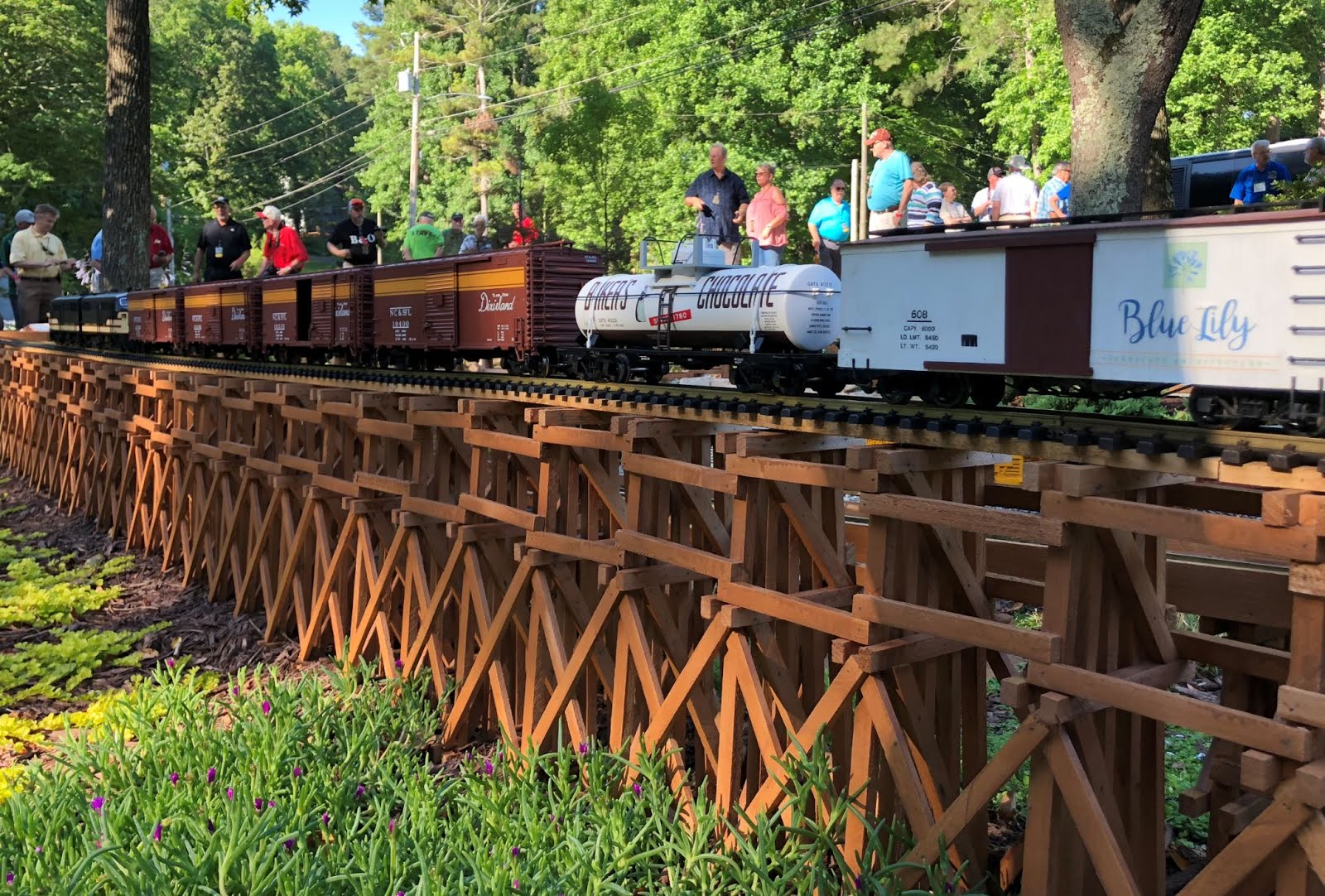
Cedar Creek: This railroad featured some very long trestles with two operating loops. While the railroad is built on a slope, the use of trestles keeps the track relatively level.

Cedar Creek: One of the two loops is in a figure eight and cross over itself.

Cedar Creek: A couple of F-units pulling a freight train.

Deck Town & Big Stump Railroad | Dave Bennett and Jaime Hernandez | Woodstock, GA

Dave runs Train Installations, LLC, a business that builds and installs model railroads of all gauges. So I wasn't surprised to see such a professional looking garden train in the yard. The railroad in a single track out-and-back with reversing loops on each end. And there was a second small logging railroad.

Deck Town & Big Stump: The spacious shop is in a barn-shaped structure with a cupola. So jealous.

Deck Town & Big Stump: There were a number of logging scenes along the railroad, including this sawmill.

Deck Town & Big Stump: I enjoyed this use of a stump as a viewing platform, and a log in the background as a logging camp.

Deck Town & Big Stump: I think my favorite feature was this burned out trestle in the background. They had recently replaced an aging trestle and rather than tossing the old one, it was burned to look like it had been destroyed by a fire, then moved to the background so it looked like an abandoned line.

Deck Town & Big Stump: A project underway in the shop is this beautiful historic model with working trains for a museum in Sarasota, Fla.

Grand Western Mining Company | James and Sally Bando | Woodstock, GA


Grand Western Mining Company: This railroad was built on a raised layout with live steam in mind, with multiple tracks allowing simultaneous train operation. Live steam engines could run around a completely level track, while battery powered locomotives could use a folded dogbone loop with some elevation change.

Grand Western Mining Company: The vignettes were mostly western and mining themed. 

Grand Western Mining Company: There were also indoor HO railroad layouts, including this great mining scene.

Just Damn and Southern | Steve Bohn | Canton, GA

Just Damn and Southern: The railroad passed around a large pond, a firepit and of course a big red barn.

Larry & Peggy Lewallen | Marietta, GA

Beautiful curved trestle leading to a bridge over a lower track. There are three loops altogether.

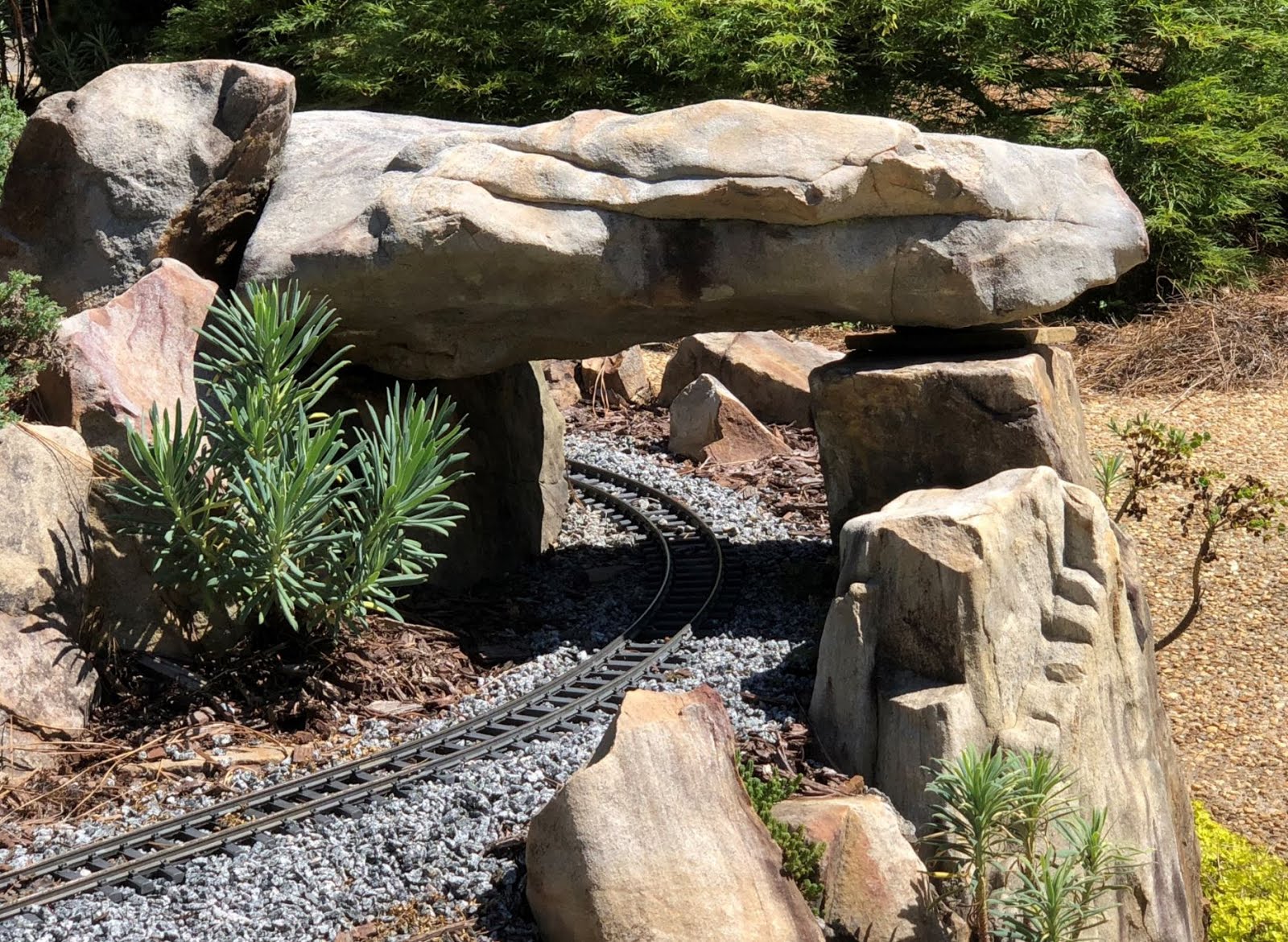
I really liked this natural stone tunnel on a curve.

Another view of the curved trestle, passing twice over another track, using two different bridge types.

Caroline's Point Railroad | Dave Booker | Kennesaw. GA


Caroline's Point: Last railroad visit of the day was the Caroline's Point Railroad, which features multiple bridges over a dry creek bed. At least it was dry when we were there.

Caroline's Point: 

Caroline's Point: There was also a big HO layout inside, featuring this big paper mill.

Caroline's Point: Another view along the HO layout, showing a wood chip transfer station. A truck is being lifted to unload wood chips, while empty high-sided wood chip hoppers are waiting on the siding.


Tuesday, June 5, 2018

Deadwood Central Railroad

I was in Huntsville, Alabama a couple days ago and had the chance to visit the Deadwood Central Railroad, a truly amazing example of garden railroading. It models the town of Deadwood, South Dakota and the surrounding area, and is named after one of that region's early railroads. The owner, Dave Roesler, grew up in Deadwood and most of the structures historically replicate actual buildings in Deadwood from when he was a child in the 1950s.

A Deadwood Central local train crossing the creek with the help of a beautiful Pratt through truss bridge.

The railroad occupies a sloped area about 90 x 50 feet with a water feature running through it. It is filled with rocks and boulders and at first I assumed that all of them had been hauled into place. But it turns out much of the rock was there to start with and it provided the inspiration and guided plans for how the railroad would be laid out. Rather than starting with a blank canvas, Dave worked with and around the existing boulders, moving them when necessary and sometimes cutting through them, just like a real railroad would do. There are a couple of beautiful canyons which have been cut down into the existing terrain.

There is a large loop, probably about 250 feet, with many sidings for multiple industries. Just like the buildings in the town of Deadwood, the surrounding industries are modeled after actual structures that were around Deadwood.

Dave caught the railroading bug in 2002 with the purchase of a Deadwood Central steam engine. But it wasn't until around 2009 that construction on the railroad started, so this is still a relatively young railroad, and it's not done yet. There are more buildings he wants to add, and one of his next big projects will be adding lighting to the buildings.

I took about a hundred pictures but obviously can't share them all here. I hope you enjoy the ones I selected. I'm in Atlanta right now for the 2018 National Garden Railway Convention, so expect more garden railroad pictures soon!

Train pulling into the town of Deadwood, S.D.

This use of a retaining wall on top of the natural rock outcrop allows the railroad to continue around the curve without a change in slope. The retaining wall is built using a natural rock bathroom tile -- an idea I plan on stealing for the PE&A.

A close-up view of the lumber mill. It is busy producing square timbers for use in the mine.

The largest structure -- the mine head house and crusher building -- sits at the highest point on the railroad.

The Deadwood Central rolling stock has been custom painted with a weathered look.

I really liked this double track drop-girder bridge.

This station in the town of Deadwood was modeled after an actual station of the Fremont, Elkhorn and Missouri Valley Railroad. It was scratch built using historic plans from the original building.

The DeSmet stamp mill.

Here's one example of a cut that was actually cut into the existing rock. It looks incredibly real -- because it is.

I forget what this structure is, but it was another large structure that I really liked and was situated perfectly in its environment.

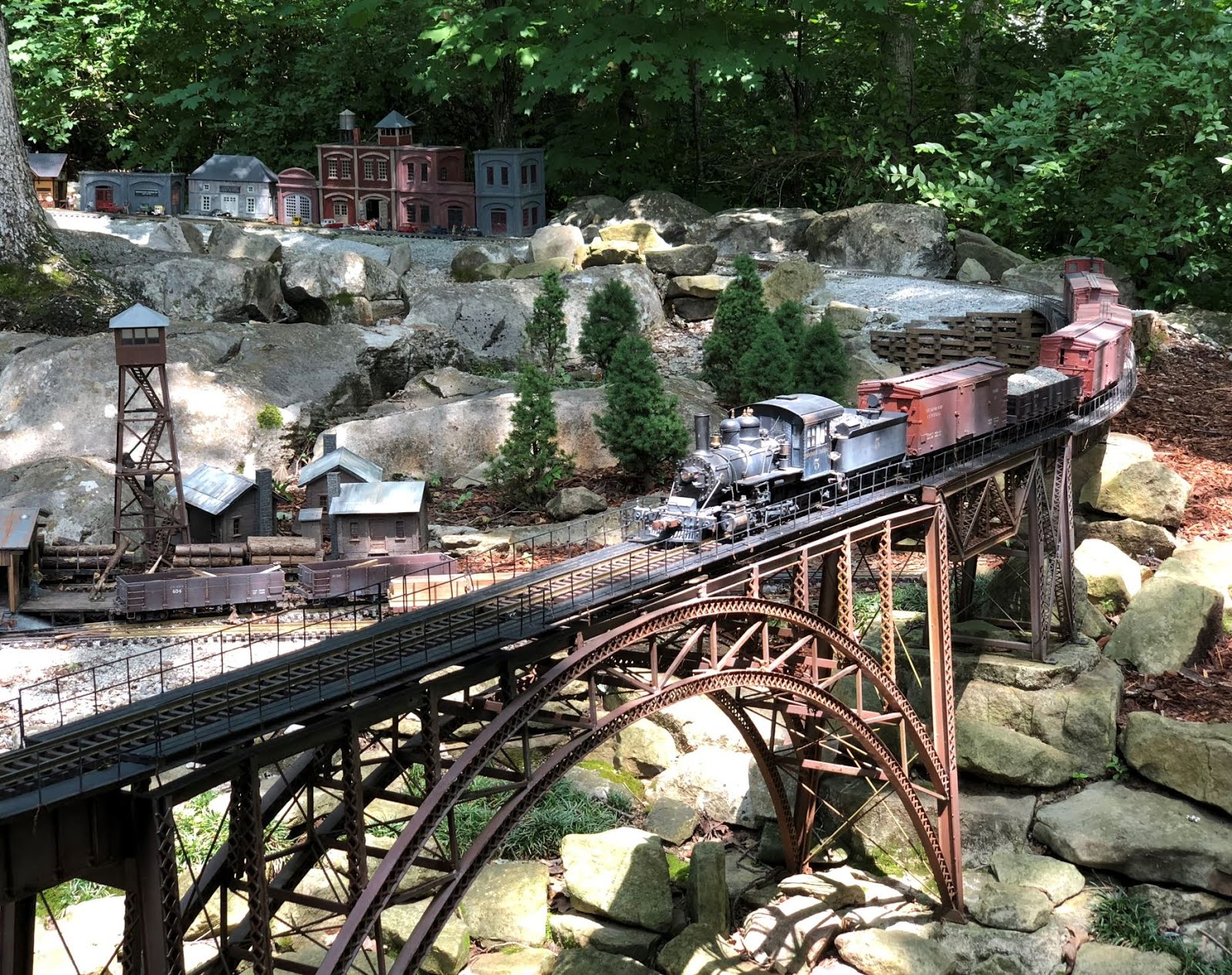
This arched bridge greets the visitor to the Deadwood Central when they arrive. Made of steel and custom built by Mainline Bridges (as were the other bridges), it is anchored on concrete foundations poured on and around the rocks. The amount of detail in this and the other bridges is amazing, one of the standout features of this railroad.