Pages

Saturday, June 9, 2018

Update from the 34th National Garden Railway Convention

I've been in Atlanta this week at the National Garden Railway Convention and while I was originally hoping to post an update each day, I've been so busy that I haven't had a chance until today. In the past three days I visited 18 garden railroads in the Atlanta area and taken hundreds of pictures. Not to mention visits to museums, train clinics, shopping and some great dinners. And a truly fabulous performance by Joan Armatrading (which, while having nothing to do with trains, was the highlight of my time in Atlanta).

While I would love to do a feature post on every railroad I visited, time and practicality dictate that I abbreviate and consolidate. So to start, here are pictures from the eight railroads I visited on Wednesday.

LP & CL Railroad | Chris Haon | Marietta, GA

The first railroad I stopped at on Wednesday looked really familiar and then I realized I had seen a few videos of this railroad online, specifically Southern F-units pulling long trains. Here's a link to a sample video. This is a very fun an eclectic layout in a street-facing yard with three large loops, a side yard with a turntable, and a spur into the garage where the trains are stored. The railroad is about a dozen years old.

LP & CL: Turntable with train sheds.

LP & CL: Freight trains passing on a double track bridge.

LP & CL: Freights passing the passenger depot.

LP & CL: The mainlines pass under this Warren truss bridge, which supports the spur into the garage.

Kinzel Springs Railroad | Richard and Fredericka Garlinghouse | Marietta, GA


Kinzel Springs: I really enjoyed this icing facility, with a few reefers lined up for refilling.

Cedar Creek Railroad | Russ and Leslie Bundy | Marietta, GA

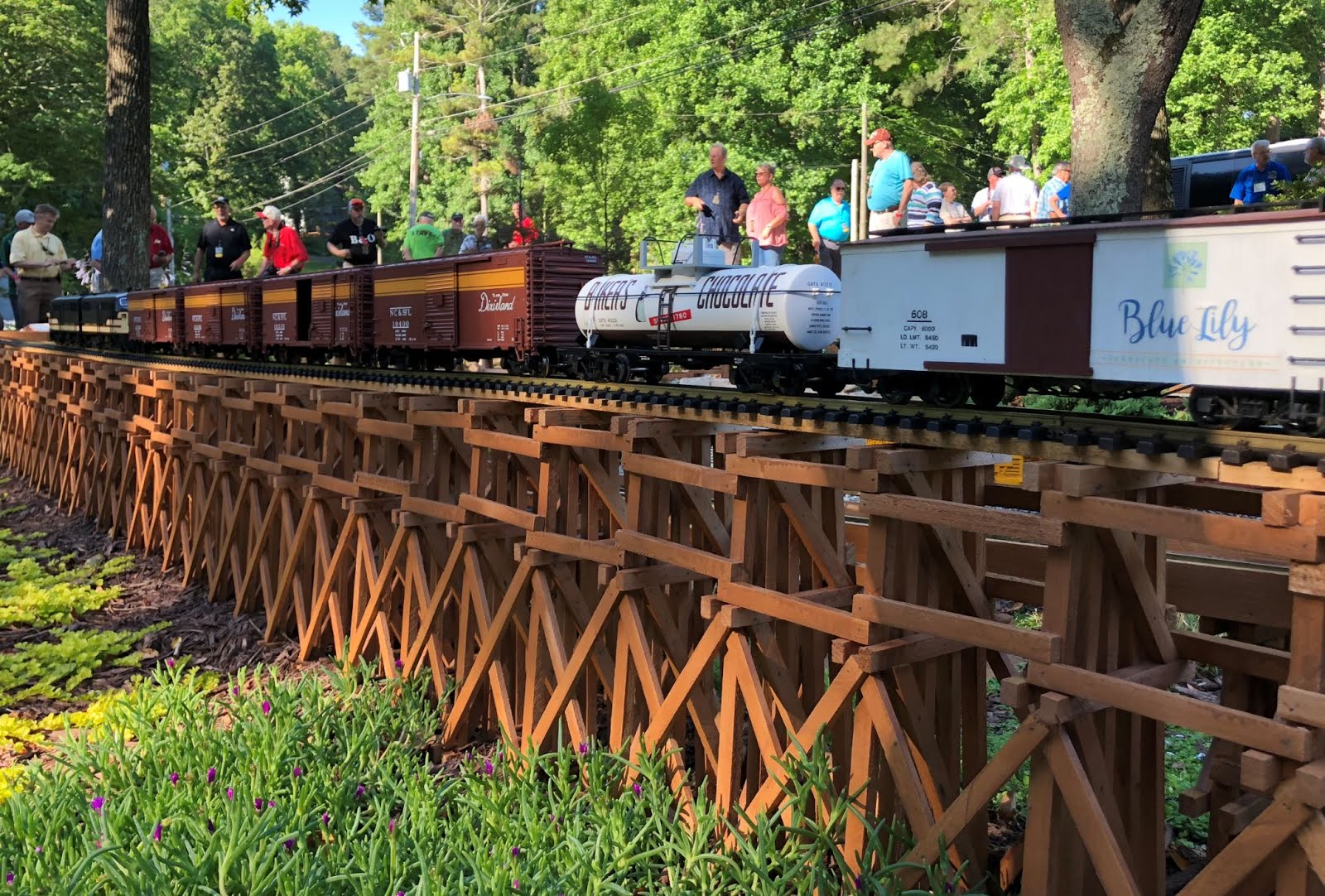
Cedar Creek: This railroad featured some very long trestles with two operating loops. While the railroad is built on a slope, the use of trestles keeps the track relatively level.

Cedar Creek: One of the two loops is in a figure eight and cross over itself.

Cedar Creek: A couple of F-units pulling a freight train.

Deck Town & Big Stump Railroad | Dave Bennett and Jaime Hernandez | Woodstock, GA

Dave runs Train Installations, LLC, a business that builds and installs model railroads of all gauges. So I wasn't surprised to see such a professional looking garden train in the yard. The railroad in a single track out-and-back with reversing loops on each end. And there was a second small logging railroad.

Deck Town & Big Stump: The spacious shop is in a barn-shaped structure with a cupola. So jealous.

Deck Town & Big Stump: There were a number of logging scenes along the railroad, including this sawmill.

Deck Town & Big Stump: I enjoyed this use of a stump as a viewing platform, and a log in the background as a logging camp.

Deck Town & Big Stump: I think my favorite feature was this burned out trestle in the background. They had recently replaced an aging trestle and rather than tossing the old one, it was burned to look like it had been destroyed by a fire, then moved to the background so it looked like an abandoned line.

Deck Town & Big Stump: A project underway in the shop is this beautiful historic model with working trains for a museum in Sarasota, Fla.

Grand Western Mining Company | James and Sally Bando | Woodstock, GA


Grand Western Mining Company: This railroad was built on a raised layout with live steam in mind, with multiple tracks allowing simultaneous train operation. Live steam engines could run around a completely level track, while battery powered locomotives could use a folded dogbone loop with some elevation change.

Grand Western Mining Company: The vignettes were mostly western and mining themed. 

Grand Western Mining Company: There were also indoor HO railroad layouts, including this great mining scene.

Just Damn and Southern | Steve Bohn | Canton, GA

Just Damn and Southern: The railroad passed around a large pond, a firepit and of course a big red barn.

Larry & Peggy Lewallen | Marietta, GA

Beautiful curved trestle leading to a bridge over a lower track. There are three loops altogether.

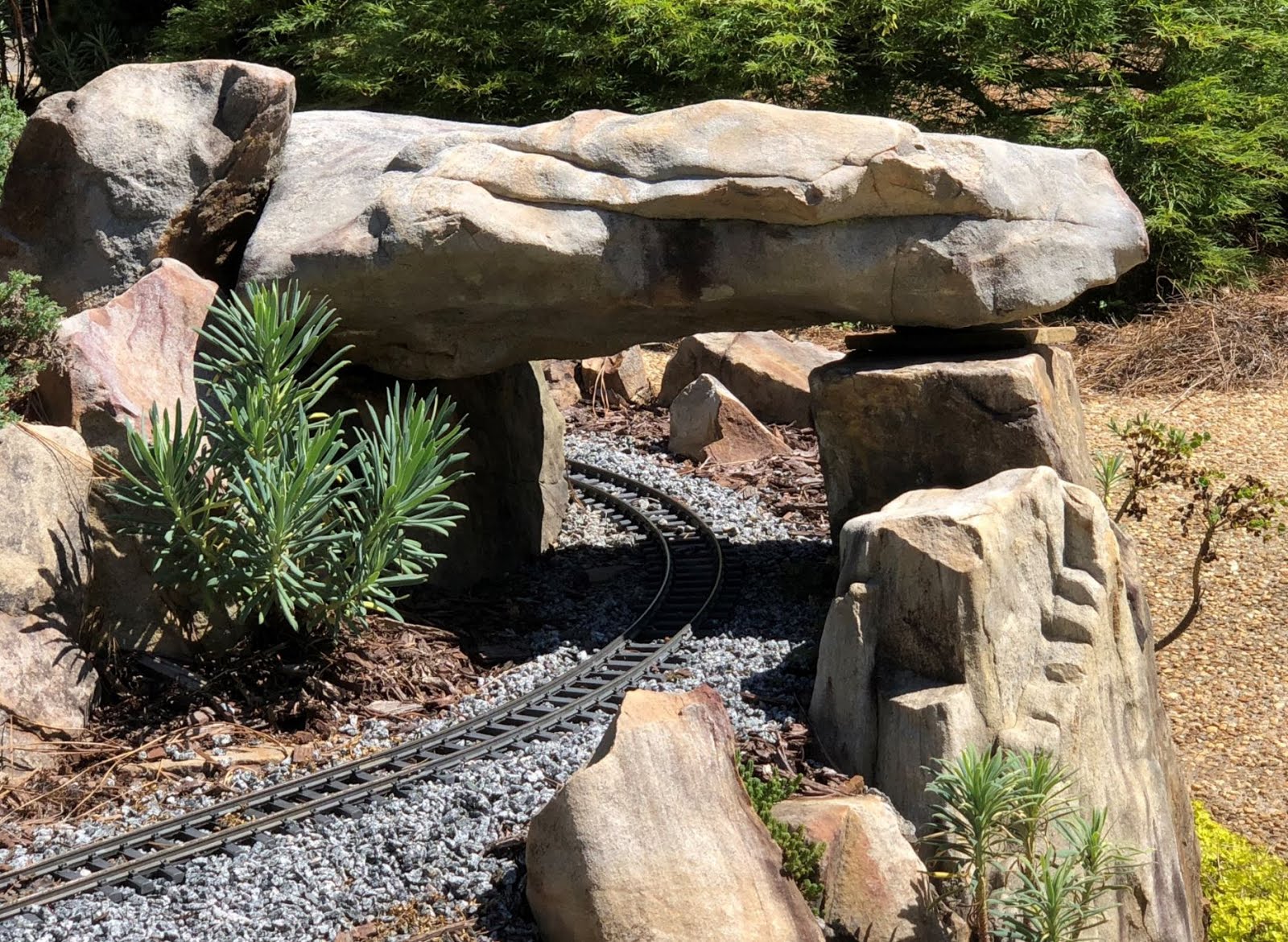
I really liked this natural stone tunnel on a curve.

Another view of the curved trestle, passing twice over another track, using two different bridge types.

Caroline's Point Railroad | Dave Booker | Kennesaw. GA


Caroline's Point: Last railroad visit of the day was the Caroline's Point Railroad, which features multiple bridges over a dry creek bed. At least it was dry when we were there.

Caroline's Point: 

Caroline's Point: There was also a big HO layout inside, featuring this big paper mill.

Caroline's Point: Another view along the HO layout, showing a wood chip transfer station. A truck is being lifted to unload wood chips, while empty high-sided wood chip hoppers are waiting on the siding.


Tuesday, June 5, 2018

Deadwood Central Railroad

I was in Huntsville, Alabama a couple days ago and had the chance to visit the Deadwood Central Railroad, a truly amazing example of garden railroading. It models the town of Deadwood, South Dakota and the surrounding area, and is named after one of that region's early railroads. The owner, Dave Roesler, grew up in Deadwood and most of the structures historically replicate actual buildings in Deadwood from when he was a child in the 1950s.

A Deadwood Central local train crossing the creek with the help of a beautiful Pratt through truss bridge.

The railroad occupies a sloped area about 90 x 50 feet with a water feature running through it. It is filled with rocks and boulders and at first I assumed that all of them had been hauled into place. But it turns out much of the rock was there to start with and it provided the inspiration and guided plans for how the railroad would be laid out. Rather than starting with a blank canvas, Dave worked with and around the existing boulders, moving them when necessary and sometimes cutting through them, just like a real railroad would do. There are a couple of beautiful canyons which have been cut down into the existing terrain.

There is a large loop, probably about 250 feet, with many sidings for multiple industries. Just like the buildings in the town of Deadwood, the surrounding industries are modeled after actual structures that were around Deadwood.

Dave caught the railroading bug in 2002 with the purchase of a Deadwood Central steam engine. But it wasn't until around 2009 that construction on the railroad started, so this is still a relatively young railroad, and it's not done yet. There are more buildings he wants to add, and one of his next big projects will be adding lighting to the buildings.

I took about a hundred pictures but obviously can't share them all here. I hope you enjoy the ones I selected. I'm in Atlanta right now for the 2018 National Garden Railway Convention, so expect more garden railroad pictures soon!

Train pulling into the town of Deadwood, S.D.

This use of a retaining wall on top of the natural rock outcrop allows the railroad to continue around the curve without a change in slope. The retaining wall is built using a natural rock bathroom tile -- an idea I plan on stealing for the PE&A.

A close-up view of the lumber mill. It is busy producing square timbers for use in the mine.

The largest structure -- the mine head house and crusher building -- sits at the highest point on the railroad.

The Deadwood Central rolling stock has been custom painted with a weathered look.

I really liked this double track drop-girder bridge.

This station in the town of Deadwood was modeled after an actual station of the Fremont, Elkhorn and Missouri Valley Railroad. It was scratch built using historic plans from the original building.

The DeSmet stamp mill.

Here's one example of a cut that was actually cut into the existing rock. It looks incredibly real -- because it is.

I forget what this structure is, but it was another large structure that I really liked and was situated perfectly in its environment.

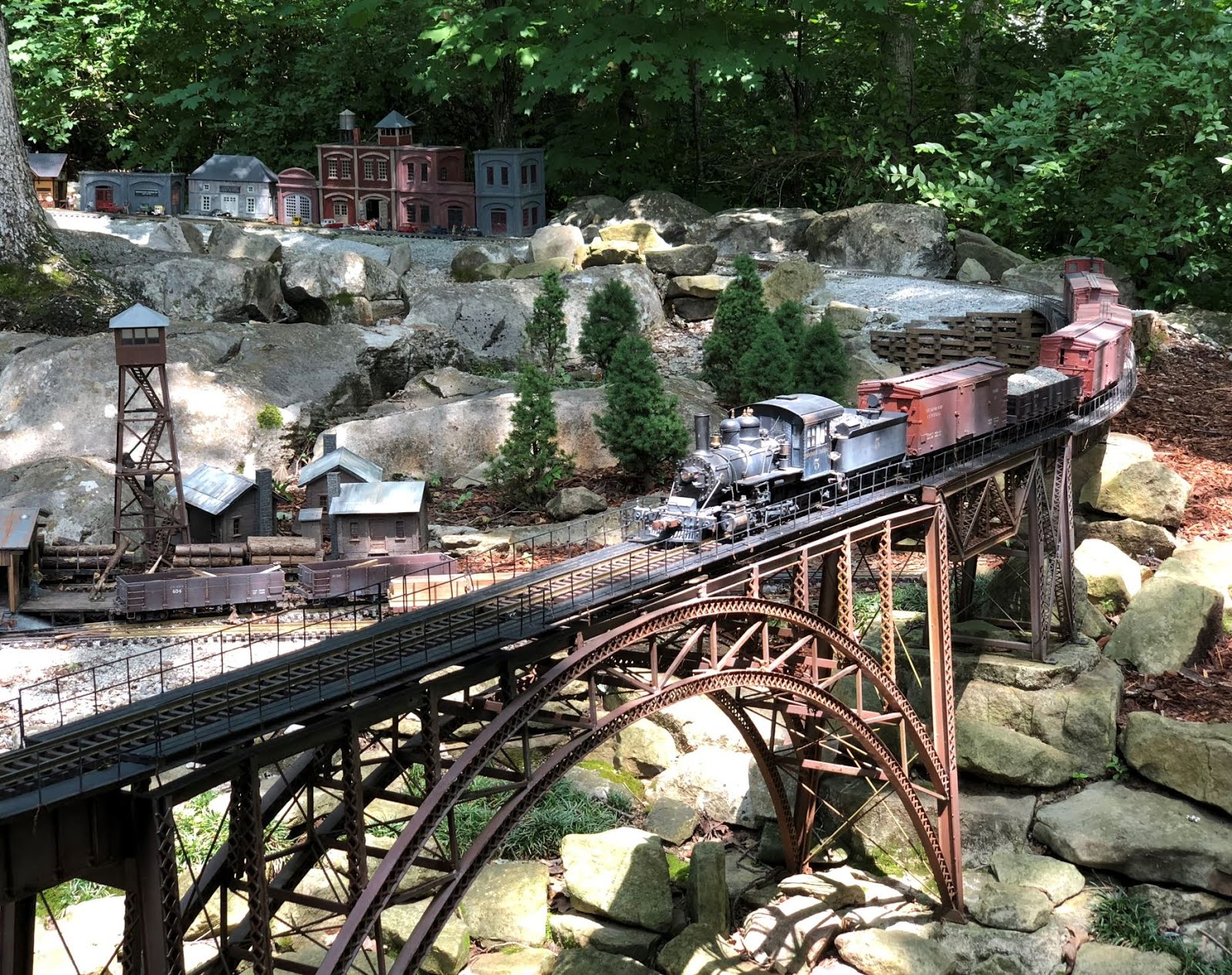
This arched bridge greets the visitor to the Deadwood Central when they arrive. Made of steel and custom built by Mainline Bridges (as were the other bridges), it is anchored on concrete foundations poured on and around the rocks. The amount of detail in this and the other bridges is amazing, one of the standout features of this railroad.

Monday, May 28, 2018

New Orleans Streetcars

After riding on streetcars in San Francisco a few weekends ago, this past week I was in New Orleans and had the opportunity to ride on that city's historic streetcars.

Streetcar on Canal Street headed for the cemeteries. This has an old time look but it is a modern streetcar. Note the faux clerestory on top, which is used to house air conditioning equipment.

Like many cities New Orleans had an extensive streetcar network (about 200 miles) in the late 19th and early 20th century. And just like what happened in most of those cities, the individual streetcar lines merged over time, eventually came under public ownership, and then were shut down one by one in favor of buses. Conversion of streetcars to buses in New Orleans started in 1924 and by 1964 all of the lines were shut down with the exception of the St. Charles Line.

Today the St. Charles Line operates using 35 green and crimson Perley Thomas streetcars built in North Carolina in 1923 and 1924. They are double-ended and have front and rear doors on both sides of the car. The reversible mahogany seats and exposed incandescent bulbs immediately take the rider back in time.

The St. Charles Line shares the roadway with vehicles downtown, as you can see here at the corner of Carondolet and Canal streets. Once the line moves out of downtown, it mostly runs along a grass meridian down the center of St. Charles street.

An outbound St. Charles Line car passing the entrance to Loyola University.

The origins of the St. Charles Line go all the way back to 1835. The line was steam powered at first, then horse powered, then electrified in 1893. The route was adjusted a few times during the 19th century, but has remained mostly unchanged since 1893. Due to its longevity and historical significance, the St. Charles Line was granted national historic landmark status in 2014.

The Riverfront Line opened in 1988 and today runs along the Mississippi river for a little over a mile, with the convention center at one end and the French Market at the other. The cars that run along this line are nearly identical to the Perley cars on the St. Charles line, but were manufactured recently. All streetcars in New Orleans, regardless of age, have a similar style and dimensions, allowing any equipment to move between lines when needed, as happened following Hurricane Katrina.

A northbound Riverfront Line car, about to head underneath the Four Seasons Hotel. The two pairs of tracks on the left are for southbound and northbound streetcars. The tracks on the right are a freight line, the New Orleans Public Belt Railroad (NOPB), the local switching railroad that provides service to industries along the waterfront.

The other lines are more modern additions -- the Canal street lines (two lines, or one line with two branches, depending on how you look at it) began running in 2004, 40 years after the streetcar service along Canal Street had stopped. These lines use modern equipment, but they are built in the same style as the historic Perley cars. The best thing about these cars—air conditioning!

The latest line is the Rampart-St. Claude streetcar which just opened in 2013 and then extended in 2015. This was the only line I didn't get a chance to ride.

Outbound car at the end of the line on Canal Street. In preparation for heading back the other way, the streetcar operator is raising the trailing trolley pole.

A reminder for drivers at the end of each line to check their poles before reversing direction.

Interior view of one end of a car operating along Canal Street. As the cars are reversible the same operational and fare equipment is installed at each end.

End of the line for the City Park line, where two cars are waiting to head back on a return trip to Canal Street. Just ahead is a very short stretch—less than a hundred feet—where there is single track running, necessitating signals and manual switch throwing by the streetcar operators.

Tucked away in a corner of the New Orleans Botanical Garden is the Historic New Orleans Train Garden.

While I got to see the layout, trains weren't running the day I visited. If I had planned better I would have made sure to visit on day they were running trains! The layout has over 1,300 feet of track and has buildings representative of different neighborhoods in New Orleans.

Yet one more thing I didn't have the chance to enjoy was a miniature train ride. The approximately two-foot gauge track winds its way through part of the park and over a bridge.

Wednesday, May 16, 2018

Rolling Stock: 2-bay Covered Hopper (CNW 169322)

I acquired a couple of new cars over the winter that haven't been featured in blog posts yet, including this beautiful Chicago and North Western Railway two-bay covered hopper, number 169322. While this is a departure from my typical BN green cars, the CNW is one of my favorite railroads and I really enjoy the yellow color, which complements BN green very well.


Chicago and North Western 169322

This is the third AristoCraft two-bay covered hopper I've acquired. I also have one in Union Pacific livery and one in Burlington Northern, which you can see in this previous blog post.

A few links of interest:


In other news: mole damage! I had a mole earlier this year but it was dispatched quickly after it appeared. A new mole moved in last week and has pushed up three mounds so far in the railroad area of the yard, two of which have destroyed part of the creek bed, just downstream from the high bridge.

Mole hills or mountains?


Tuesday, May 15, 2018

Muni Streetcars

The garden railroading season has been underway for close to two months but I haven't had any new posts in ages. As I got a chance to ride on streetcars a couple weekends ago when I was in San Francisco, I thought I’d include a few pictures of some streetcars I saw, three PCCs and one Peter Witt. The streetcars are owned and operated by the San Francisco Municipal Railway, also known as Muni, which has one of the largest collections of operational streetcars in the world. Muni typically operates about 20 different streetcars from their historic fleet each day on two routes, the E-line and F-line. This map shows what cars are in operation right now.

Muni No. 1815


No. 1815 is a type of streetcar is known as a Peter Witt, named after the commissioner of the Cleveland Railway from 1911-1915. During his tenure he designed a new streetcar and built a prototype which was introduced in 1914. An initial order of 130 cars was delivered to Cleveland Railway in 1915 and 1916. This style of streetcar was adopted in many American cities and the design was exported around the world, and they were especially popular in some Italian cities.

About 500 Peter Witt streetcars were built for use in Milan, and many of those are still in operation in Milan today. Muni has acquired 11 cars from Milan; this particular one was built in 1928, acquired from Milan in 1998, and is painted in the style that has been in use in Milan since the 1970s.

More information on No. 1815 and the other Milan streetcars Muni owns can be found here.

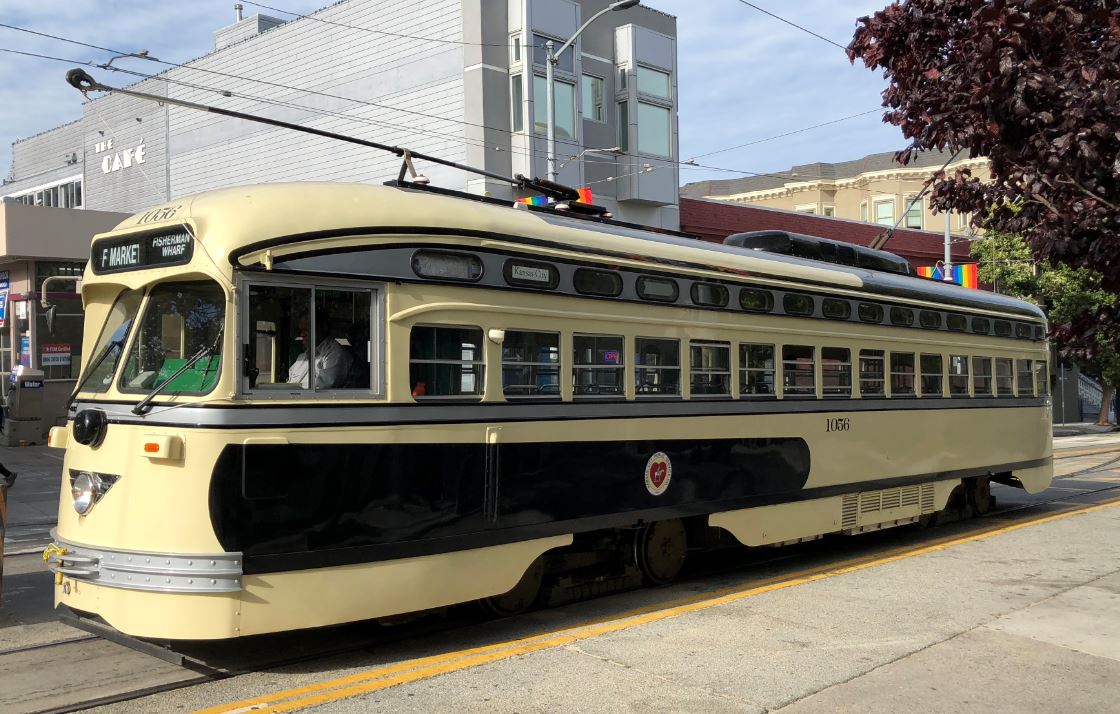
Muni No. 1056

This car was built in 1948 by the St. Louis Car Co. for the Philadelphia Tracition Co. and acquired by Muni in 1992. It was restored in 1993 and again in 2013. Like many Muni streetcars, its livery doesn’t reflect its origins. Today it is painted in tribute to Kansas City, which ran PCC streetcars from 1941 to 1957. I talked a little bit about PCCs in a previous post when I acquired an AristoCraft PCC for the PE&A. While my PE&A is a pre-war style PCC, No. 1056 is a post-war style PCC.

More information on No. 1056 can be found here.

Muni No. 1070

This PCC was built in 1946 by the St. Louis Car Co. for the Twin City Rapid Transit Co. (Minneapolis/St. Paul) where it was in operation until 1953. It was one of about 30 PCCs sold in 1953 to New Jersey Transit in Newark, which continued to operate PCCs all the way up to 2001. The following year this car came to San Francisco for a test run and it was then one of 11 cars that were purchased from New Jersey Transit by Muni in 2004. The livery it sports today is the original 1950s style which it would have had when it first went into operation in New Jersey.

More information on No. 1070 can be found here.

Muni No. 1075

This is a sister car to 1070 and had an identical history. It is also one of the 11 cars Muni purchased from New Jersey Transit in 2004. Unlike 1070, this one has been painted to honor the Cleveland Transit System which ran PCCs from 1946 to 1953.

More information on No. 1075 can be found here.


Sunday, March 11, 2018

PE&A opens for spring

The beautiful weather this weekend marked the start of spring. The plum trees are starting to bloom, not to mention the forsythia, camellias and even the Mahonias that have full sun. This was also the first opportunity to spend a few hours on PE&A maintenance. And that means putting down new ballast where it had settled or eroded away over the winter.ago. While the work is tedious, putting new ballast in place ensures the rails stay in place and are safe for operation without speed restrictions.

BN 5406 out for a run on a bright day.

A before and after example showing a section of track where the ballast had eroded away from the  ties on the left, and new ballast has been put in place on the right.

The crocus along the stream bed.

Ballast work around the at-grade crossing.

The new growth on the euphorbia is beautiful, but this one has grown so long it's interfering with the tunnel entrance and will need to be cut back.

After all the ballast work was done, I made another round to clean off the top rail surface. Then it was time to take a train out for a run. I also wanted to test how many cars BN 5406 could pull up the grade.

One more view of the crocus enjoying the sunny day.